Ontology Studio Webinar - Recorded Session
Enterprise AI doesn't fail because of bad models. It fails because the model has no causal understanding of how your business work

Enterprise AI does not fail because of bad models. It fails because the model has no causal understanding of how your business works.
In this session we go live with Ontology Studio and show what happens when you give AI a causal world model of your business instead of a semantic layer.
CHAPTERS
00:00 Ranjan introduces DecisionX and session agenda
03:31 Panel discussion begins · Ashwini Agarwal on enterprise AI evolution
14:05 The mushroom story · Why AI risk is unacceptable in production
16:23 Why enterprises block GenAI from going live
20:17 Build vs buy · Ashwini on the right approach for enterprises
23:31 Rishank · Semantic layer vs Ontology State Graph
25:09 The three ontology layers · Data, Domain, Decision
27:20 Finite state machine · The computer science behind it
28:32 Ontology Studio LIVE demo begins
31:13 Make · How agents build the ontology automatically
35:47 Manage · 3D causal world model walkthrough
43:03 Maintain · Conflict detection and resolution
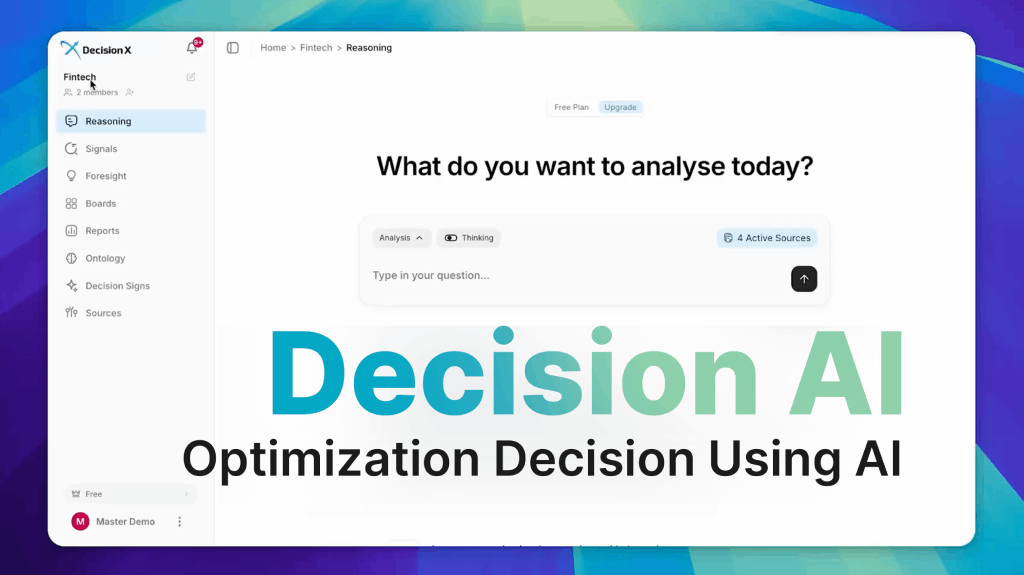
47:17 Reasoning · How contextual answers are generated
49:49 Live demo · Top decisions on loan repayment delays
53:05 Live RCA · Why has 15 DPD deteriorated?
55:19 Audit trail and reasoning chain walkthrough
56:10 Q&A · Map vs mind · Retrieval vs causal reasoning
59:44 Spider 2.0 · #2 globally on enterprise reasoning benchmark
WHAT WE COVER
WHY ENTERPRISES BLOCK AI FROM PRODUCTION ·
Ashwini Agarwal, ex-Accenture, Capital One, Brillio, 20 years advising enterprise AI on both the buy and sell side, opens with why enterprises with large AI budgets are still blocking GenAI from going live in production. The problem is not capability. It is accountability. No audit trail. No causal chain. No way to explain the output to a regulator, an investor, or a CXO. He shares the mushroom story where AI confidently gave wrong advice with fatal consequences and its response was sorry I will learn from this for next time. That risk is simply not acceptable in regulated enterprise workflows. If you have a car that can go fast, you also need seatbelts and airbags. Same applies to enterprise AI.
SEMANTIC LAYER VS ONTOLOGY STATE GRAPH ·
Rishank, Chief Ontology Officer at DecisionX, breaks down why a semantic layer is a dictionary and an Ontology State Graph is a world model. A semantic layer teaches AI keywords. Keywords change. It breaks. For any computer science nerd in the audience, all of these principles come from treating ontology as a finite state machine, not a graph modelling problem. Particular states, transitions, outcomes. An Ontology State Graph evolves as your business does. One is a flat map of what exists. The other is a living model of how your enterprise reasons and decides.
DATA, DOMAIN AND DECISION · THE THREE ONTOLOGY LAYERS ·
Ranjan Kumar, Founder and CEO of DecisionX, walks through the three layer architecture. Data ontology is what your enterprise contains, entities, metrics, relationships, lineage, built bottom up by agents across 49 undocumented sources. Domain ontology is what it means, your industry context, your processes, your rules, layered top down. Decision ontology is why you chose, goals, actions, outcomes, and decisions as causally connected first class objects, the world's first. Together they form your Ontology State Graph, a living causal model of how your enterprise thinks. Data, domain, decisions together is the most comprehensive way to look at everything happening in an enterprise.
MAKE. MANAGE. MAINTAIN. ·
A live walkthrough of the three modules inside Ontology Studio. Make builds the ontology automatically. Agents extract domain taxonomy, business metrics, decisions, and discussions. What used to take months of manual ontology work done in 7 days. Manage connects everything into a 3D causal world model with 16 relationship node types. The data graph and decision graph connected. Maintain keeps it sharp. Conflict detection across 6 categories resolved by humans in plain English in real time. Every judgment captured. The system gets smarter with every call.
LIVE RCA DEMO · WHY HAS 15 DPD DETERIORATED? ·
The session goes live on real fintech risk data. No pre-loaded answers. The system forms hypotheses including macro shock, origination vintage, cohort mix, and collection behaviour. Tests each against structured and unstructured data. Invalidates the ones the evidence does not support. Returns a bottom line with the most likely driver, the less likely ones, what was ruled out and why, with a full reasoning chain, table joins, and referenced decision log. Auditable. Traceable. Explainable. Unless the causal model exists in your ontology, the system hallucinates and does not give you a grounded answer in your organisation.
HUMAN IN THE LOOP ·
When agents hit a conflict, two interpretations, one ambiguity, it does not get silently resolved. It gets surfaced. The human resolves it in plain English. No queries. No schema edits. The ontology sharpens in real time. Every judgment captured. Not AI instead of humans. Not humans instead of AI. The right balance, always.
THE PROOF ·
Ranked #2 globally on Spider 2.0 Lite, the hardest enterprise reasoning benchmark in the world, ahead of Samsung, Snowflake and Tencent. Number one is the Oracle AI Science team. Not a retrieval win. A reasoning win. 49 undocumented sources mapped. 247,831 entities. 7 days. What used to take months.