




Excepteur sint occaecat cupidatat non proident, sunt in culpa qui officia deserunt mollit anim id est.
Submit ticketOntology vs Knowledge Graph vs Embeddings
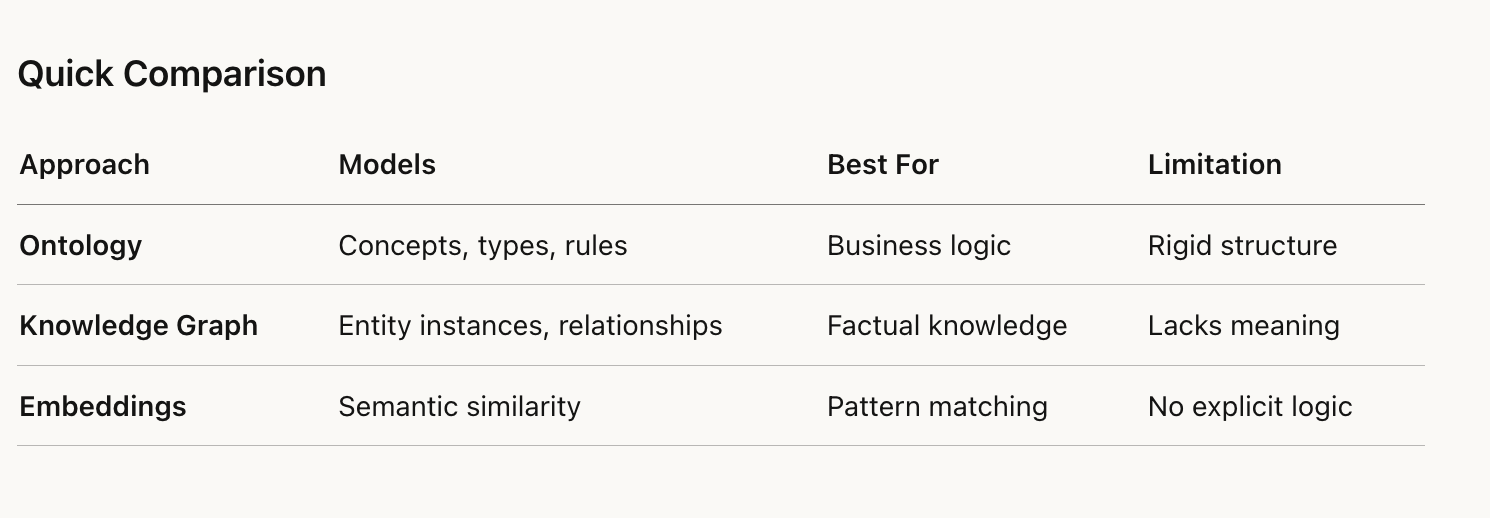
These three approaches model information differently. Ontologies define concepts and rules. Knowledge graphs store factual relationships. Embeddings capture semantic similarity.
Quick Comparison
What Is an Ontology?
An ontology is a formal representation of concepts within a domain and the relationships between those concepts.
Structure. Ontologies define:
- Classes: Customer, Product, Transaction
- Properties: Customer has name, email, credit limit
- Relationships: Customer purchases Product
- Rules: Enterprise customers have credit terms
Reasoning capability. If the system knows "Company X is an Enterprise customer" and "Enterprise customers have credit terms," it can infer "Company X has credit terms" without storing that fact explicitly.
When to use. Business logic and rules matter. You need consistent reasoning about categories. Examples: regulatory compliance, business process modeling.
Limitations. Ontologies are rigid. Adding new concepts requires updating formal structure. Maintenance overhead is high.
What Is a Knowledge Graph?
A knowledge graph is a network of entities (nodes) connected by relationships (edges) representing factual information.
Structure. Knowledge graphs store:
- Entities: "Apple Inc.", "iPhone 15", "Tim Cook"
- Relationships: "Tim Cook" → CEO_of → "Apple Inc."
- Attributes: "iPhone 15" → release_date → "September 2024"
Query capability. Knowledge graphs allow traversal: "Find all deals closed by reps in regions managed by Bob" by following relationship edges.
When to use. You need to store and query factual relationships at scale. Examples: customer relationship management, supply chain tracking.
Limitations. Knowledge graphs store facts but don't capture meaning. They know "Alice closed Deal #1234" but not what "closing" means.
What Are Embeddings?
Embeddings are numerical representations of data in high-dimensional space where semantic similarity corresponds to spatial proximity.
- Structure. Embeddings convert text into vectors (lists of numbers). Similar concepts have similar vectors.
- Similarity search. Given a query embedding, find nearby embeddings to identify semantically similar content. This enables fuzzy matching.
- When to use. You need semantic search across large document collections. Pattern recognition matters more than logical reasoning. Examples: document retrieval, recommendation systems.
- Limitations. Embeddings capture correlation, not causation. You can't interrogate why two items are similar.
How They Work Together
Production AI systems often combine approaches.
- Ontology for structure. Define business concepts and rules. "Enterprise customers have credit terms" is ontology knowledge.
- Knowledge graph for facts. Store specific instances. "Company X is an Enterprise customer" is knowledge graph data.
- Embeddings for search. Enable semantic matching. Finding documents about "customer payment issues" uses embeddings.
Example integration. An AI analyst might:
Use embeddings to find relevant documents
Use knowledge graph to retrieve factual relationships
Use ontology to apply business rules
Synthesize these inputs into analysis
Choosing the Right Approach
Use ontologies when:
- Business logic and rules are core requirements
- Consistent reasoning matters
- Domain has well-defined categories
- You need explainable decisions
Use knowledge graphs when:
- Managing many specific entities and relationships
- Traversal queries are common
- Factual accuracy at scale is priority
- Relationship structure provides value
Use embeddings when:
- Searching large unstructured content
- Semantic similarity matters more than exact matches
- Pattern recognition drives value
- Scale and speed outweigh logical precision
Use hybrid approaches when:
- You need all three capabilities
- Different query types need different mechanisms
Common Confusions
"Knowledge graphs are ontologies." Not quite. Ontologies define types and rules. Knowledge graphs store instances and facts.
"Embeddings replace structured knowledge." No. Embeddings enable fuzzy matching but don't provide logical reasoning.
"One approach is better." Depends on requirements. Ontologies excel at reasoning. Knowledge graphs excel at relationship queries. Embeddings excel at semantic search.
Technical Tradeoffs
Ontology:
- Pros: Logical reasoning, explainability, consistency
- Cons: Rigid structure, maintenance overhead
Knowledge graph:
- Pros: Relationship queries, scale, flexibility
- Cons: No inherent reasoning
Embeddings:
- Pros: Semantic search, scale, handles ambiguity
- Cons: Black box similarity, no logical structure
Closing
Ontologies, knowledge graphs, and embeddings serve different purposes. Ontologies provide logical structure. Knowledge graphs store factual relationships. Embeddings enable semantic search.
Modern AI systems increasingly combine all three, using the right tool for each capability rather than forcing one approach to handle all tasks.
.jpg)
.png)
.jpg)