



Excepteur sint occaecat cupidatat non proident, sunt in culpa qui officia deserunt mollit anim id est.
Submit ticketWhat Is an AI Analyst?
An AI analyst is software that performs analytical work traditionally done by human business analysts: reading raw data from multiple sources, identifying patterns, explaining causality, and recommending actions.
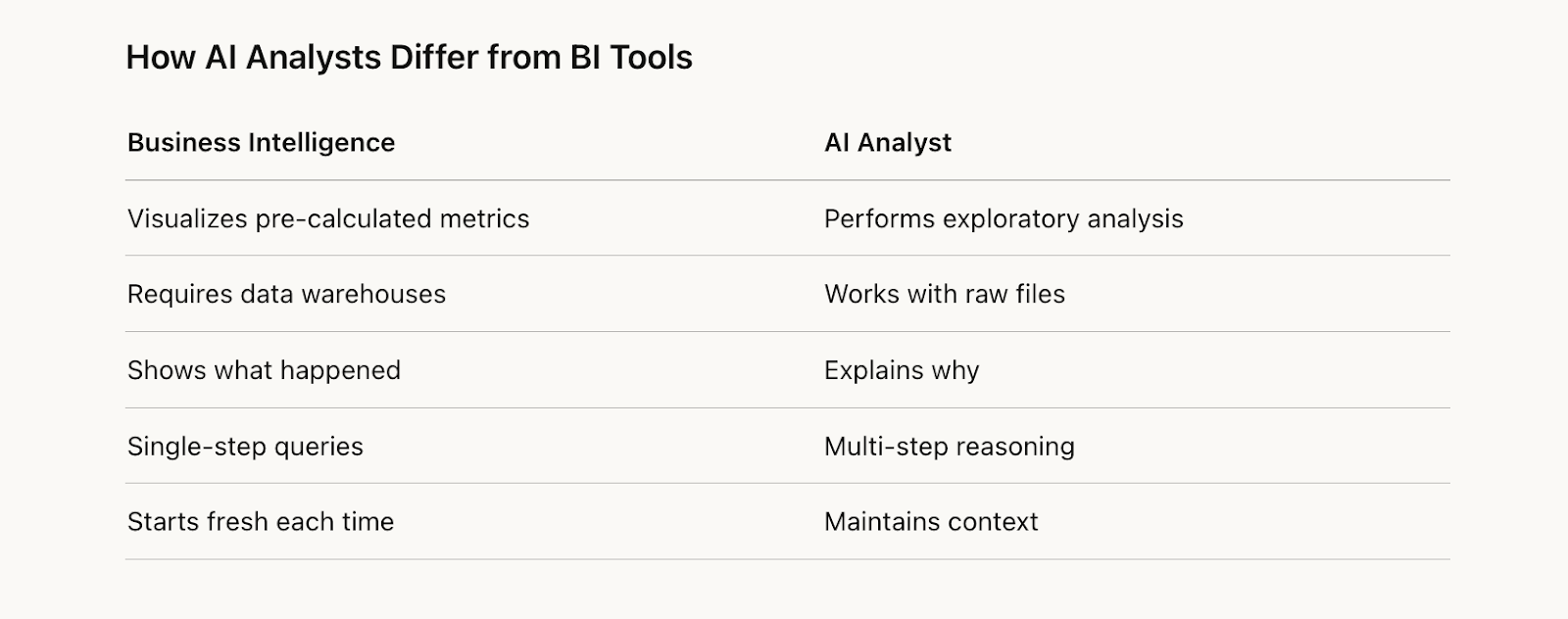
Unlike dashboards that visualize pre-calculated metrics, AI analysts reason through business questions using context-aware logic.
Core Capabilities
Multi-source data reading. AI analysts work with CSV files, Excel spreadsheets, database exports, PDF reports, and unstructured text. They don't require pre-modeled warehouses.
Context preservation. The system maintains understanding of business terminology and operational patterns across sessions.
Multi-step reasoning. AI analysts break complex questions into sub-questions, gather information, test hypotheses, and synthesize findings.
Causal explanation. Rather than showing correlations, AI analysts explain why changes occurred by identifying causal chains.
Transparent methodology. AI analysts expose their reasoning: which data they considered, what assumptions they made, and how they reached conclusions.
How AI Analysts Differ from BI Tools
How AI Analysts Differ from Copilots
Copilots assist with tasks within single applications: writing code, drafting documents.
AI analysts reason across multiple data sources to answer complex business questions: "Why did deals slow?" or "Which market should we enter?"
The architectural difference is fundamental. Copilots use visible context in your current session. AI analysts maintain persistent business context and multi-source reasoning.
Technical Architecture
Data ingestion layer. Connects to files, databases, APIs, and documents. Handles format differences.
Context engine. Builds understanding of business terminology, relationships, and logic through ontologies or knowledge graphs.
Reasoning layer. Performs multi-step analysis: breaking questions into sub-questions, gathering evidence, testing hypotheses.
Explanation generator. Translates analytical process into readable reasoning chains.
Verification interface. Allows humans to review reasoning and validate conclusions.
Typical Workflows
- Root cause analysis. "Why did conversion drop 8%?" The AI analyst examines user behavior, identifies segment changes, correlates with product modifications, and presents causal hypotheses.
- Scenario modeling. "What happens if we raise prices 15%?" The AI analyst analyzes price elasticity, segments customers by sensitivity, and projects revenue impacts with confidence intervals.
- Performance diagnosis. "Why is north region underperforming?" The AI analyst compares region metrics, examines local conditions, and identifies primary drivers.
- Opportunity identification. "Which segments should we target?" The AI analyst evaluates segment characteristics, calculates acquisition costs and lifetime value, and ranks opportunities.
What AI Analysts Cannot Do
- Real-time operational decisions. AI analysts work best on analytical questions requiring synthesis, not split-second choices.
- Strategic judgment calls. Final decisions on strategy and ethics require human judgment. AI analysts structure analysis but don't make these choices.
- Handle novel situations. AI analysts reason based on patterns in available data. Unprecedented scenarios need human creativity.
- Replace domain expertise. AI analysts synthesize data and identify patterns. They don't replace deep market knowledge or customer psychology understanding.
Implementation Considerations
- Learning period required. AI analysts need 2-4 weeks to build business context.
- Data connectivity. Systems must connect to relevant sources. Initial setup involves establishing access and configuring security.
- Human oversight necessary. AI analysts should expose reasoning for verification.
- Scope definition matters. AI analysts work best on defined problem spaces.
When AI Analysts Provide Value
AI analysts suit environments where:
- Analytical questions are recurring but non-routine
- Data exists across multiple scattered sources
- Understanding causality matters for decisions
- Speed and consistency improve over current processes
Traditional approaches may suffice when:
- Questions are simple and repetitive
- Data exists in single, well-structured source
- Visualization alone drives action
Current Limitations
- The AI analyst category is emerging. Capabilities vary significantly.
- Context building is manual. Systems require human input to establish initial understanding.
- Reasoning isn't perfect. AI analysts make mistakes. Human verification is essential.
- Cost remains high. AI analyst platforms are more expensive than traditional BI tools.
- Standards are immature. Best practices for reasoning verification and trust building are still developing.
Closing
AI analysts attempt to automate the analytical work humans perform when answering complex business questions. By combining multi-source data access, context awareness, and multi-step reasoning, they aim to make analytical synthesis faster and more consistent.
Success depends on continued progress in context learning, reasoning transparency, and demonstrated accuracy.
.jpg)
.png)
.jpg)